CHRISTOPHER ROWLANDS
1944 – 2025
I’ve been asked to write a tribute of Chris for the newsletter and I’m delighted to do so. Chris worked as an editor at Pebble Mill from 1978 until 2011 – and beyond as a freelance. He ended his career as Supervising Editor and the last programme he worked on was ‘Doctors’. He had been suffering from COPD and died peacefully, at home on 13 March.
His funeral will be on Friday 2 May, 11.00 a.m. at St. Peter’s Church, Inkberrow. I hope it will be a joyful celebration of his life, so, if you would like to come, don’t feel you have to wear sombre colours.
When Chris was fourteen he and a few schoolfriends borrowed a 16mm clockwork Bolex camera and made a film about the closing of the nearby Horsham railway line. When the little rolls of film arrived on his doorstep he looked at them, decided they made no sense, got an advance on his pocket money, bought a splicer and edited them in the correct order. That was the beginning of his editing career, a career that, along with steam railways, was almost a passion. He often said that the BBC paid him for his hobby, and when he spent a year editing my children’s TV series, ‘God’s Wonderful Railway’ he said he felt he should have paid the BBC!
He made and edited films for his school and directed and edited a documentary on Chichester Cathedral and also a festival in Sussex. When he left school he tried very hard to get into the feature film industry but it was, at that time, very much a closed shop. As he didn’t have any family to pave the way he got a job as an assistant editor working for a company called Religious Films, which had been set up by the Methodist peer Lord Rank – who founded the Rank Organisation chain of cinemas. Chris spent a large amount of his time travelling round churches explaining to clergy how to set up and run 16mm projectors. Unfortunately he didn’t get much experience in the cutting room as the editor was a naturist and could only edit creatively behind a screen, dressed solely in a pair of socks and shoes!
In 1965, at the age of 21, Chris started work at the BBC. Initially editing the film inserts for programmes such as ‘Play School’ , ‘Horizon’, ‘Dr Finlay’s Casebook’, and ‘Dr Who’. He then began working on ’24 Hours’ – now ‘Newsnight’ and then progressed to his real love, drama. We met in 1972 when we both worked on a children’s drama series, ‘Fish’. I was doing the job of continuity and we met outside a dubbing theatre in Berwick Street at 8.0 in the morning. Most of our dates included visits to the cinema. Chris at that time was editing Mike Leigh’s first film for television, ‘Hard Labour’ and to judge by Chris’s comments when we’d meet, it was!
Chris’s all-time hero was David Lean. I remember going to the Gaumont Cinema in Richmond to see ‘Ryan’s Daughter’. Slightly confused by the plot, I suddenly realised that Chris had disappeared. He was gone for some time, bursting in to the projection room to tell the operator that he was showing the film in the wrong order! The projectionist fell on him in delight. None of the film cans were labelled. He had worked out that the censor’s certificate meant it was reel 1 and the closing credits obviously meant the last reel. Chris sorted it out and we were given free tickets for the next few films.
We worked together on a number of children’s drama series – Chris later said he only married me for my continuity notes! It was only when I was working on ‘Carrie’s War’ and was given a ride on the footplate of the engine that I realised that Chris’s other passion was steam. Wanting to make a film together we spent most weekends travelling up from London to the Severn Valley Railway to make ‘Steam-upon-Severn’ – which was later transmitted by BBC Midlands.
Falling in love with the area and knowing that there was a thriving drama department at Pebble Mill, we moved from London in 1978. Chris worked on a variety of programmes – some in the Play for Today series; ‘Dangerfield’; Dalziel & Pascoe’; inserts for ‘All Creatures Great and Small’ and lastly ‘Doctors’. At a time when there was quite a bit of hostility between film and VT editors, Chris was in the forefront of transitioning film to tape to digital. Creative editing, he felt, was creative editing, whether working with the tools of film or Sony U-Matic or digital.
Chris was incredibly inventive. When I was exploring the possibility of running training courses for PA’s working in multi-camera studios, the cost of dry-hiring was prohibitive. Chris came up with the idea of turning our lounge into a two-camera studio and our dining room into the gallery, equipped with VHS play-in, a convincing autocue made from a box with a camera in the top relaying pages of script to a TV in the lounge, sound, studio talkback and the ability to record the studio output. He even rigged up a red transmission light and the extensive wiring was fed into the lounge through a cunningly-concealed hole behind the bookcase! Chris didn’t cut the hole – his skills, although many, didn’t run to that! Kay Alexander and the late Alan Towers both presented on my courses. When a friend, retired engineer Peter Hodges, came to look at it he scratched his head. It shouldn’t work, he said. But it did.
He was one of the editors working on location on the RAC rally and really enjoyed kitting out a van with the editing equipment. I spent a day with him on location in the north-east and, as we were about to drive into the forest, we were told by a marshall to go carefully as one of the rally cars hadn’t come out! Fortunately we didn’t meet it as Chris drove slowly and carefully towards the glade where we set up.
Many of you reading this will remember how Chris loved helping those new to the profession. But that was Chris – always kind, always putting himself out to help others, although the speed at which he moved could be a bit alarming when you first met him. I felt I spent much of our married life running after him bleating ‘Wait for me, wait for me!’
Chris’s over-riding love was for editing. He had two stints of directing. On ‘Jackanory’ and on ‘Blue Peter’. Offered a job on ‘Blue Peter’ Biddy Baxter said that she was sure Chris would turn it down. While at Pebble Mill Chris was approached to see if he would be interested in the new post of Post Production Manager. He wasn’t.
The three programmes Chris edited which meant the most to him were two episodes of the documentary series ‘Royal Heritage’, where, apart from editing, he spent a fascinating day sitting in Queen Victoria’s coach in the York Railway Museum with Sir Huw Weldon who fronted the series, discussing the Queen’s involvement in railways; ‘Parnell and the Englishwoman’, transmitted in 1991, which was a series set in the 19th century about Charles Stewart Parnell’s love affair with Kittie O’Shea. When Chris was editing it he sometimes didn’t get home until the small hours, especially when he edited the scene where Parnell (played by Trevor Eve) first met Kittie O’Shea (played by Francesca Annis). And lastly, of course, my own series, ‘God’s Wonderful Railway’.
And Chris was editing pretty well until the end. When Covid happened and the churches were closed, we began a short midweek reflection on a Bible reading. Members of the clergy and I contributed and Chris ended up editing them on the broadcast Avid he had on his laptop.
He enriched the lives of so many, both personally and also by those watching the programmes he edited. Perhaps I’m biased, but I felt he was a sublimely creative editor – I always thought he excelled in music sequences, such as the opening and closing of ‘My Name is Jane’ which Chris edited for John Williams as well as the music sequences in my series of books ‘Tales of the McDorwuffs’, which I made into a TV series.
Among the very many kind comments that have been made about Chris, someone wrote that he was a legend. To me he was a wonderful person and I felt privileged to share his life for over fifty years. We made films together, laughed together, involved our friends in all sorts of schemes, caravanned together and were immeasurably blessed with very full and happy lives.
He’ll be missed by so many.
Avril Rowlands
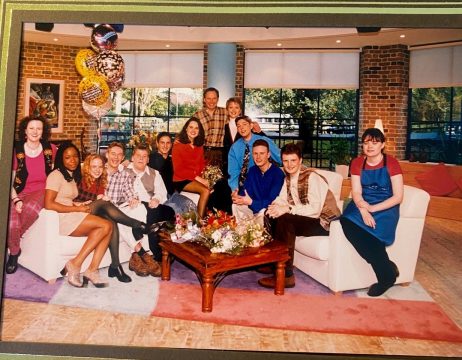
 Sorting out old photos…found this one circa 1992 and a very youthful looking young man sat on Anne and Nick’s sofa. A future highly acclaimed writer/actor, James Corden, who was our young entertainment reporter at the time!! I think he was about 14 at the time…rocking that waistcoat!
